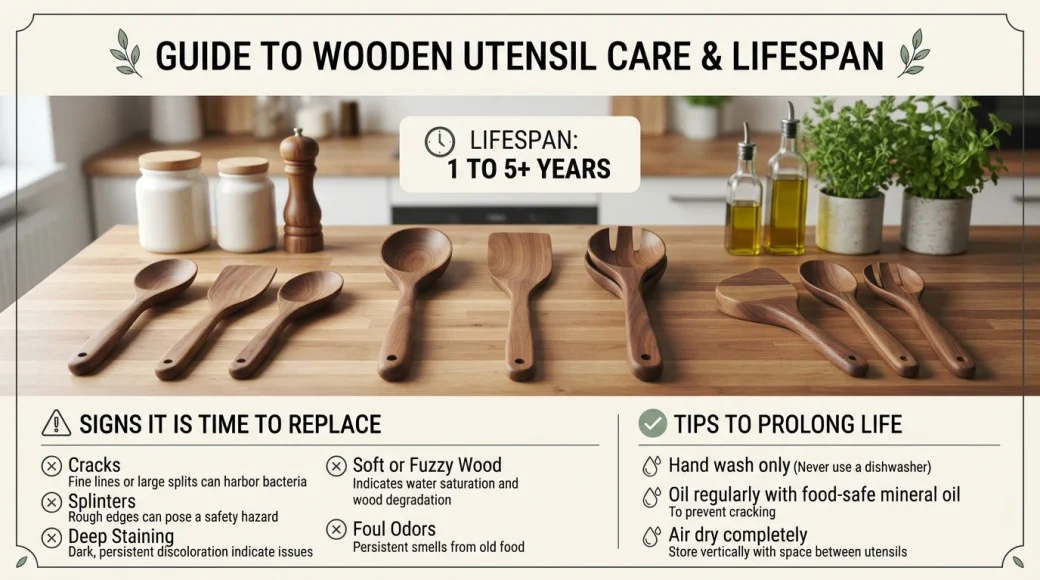
How long do wooden cooking utensils last, really? If you’ve ever stared at an old wooden spoon with a split handle and a stubborn garlic smell, wondering whether it deserves one more year, you’re not alone. The honest answer is that there isn’t a fixed number, because wood isn’t a manufactured product with a tested expiry date. How long a spoon or spatula survives depends on how it’s made, how it’s used and how it’s cared for.
This guide pulls together what kitchen experts and food-safety sources actually say, separates the firm advice from the rules of thumb, and shows you how to tell when it’s time to let go. If you’re also deciding what to buy in the first place, choosing and using wooden kitchen tools is covered in a separate guide.
How Long Do Wooden Cooking Utensils Last?
There is no official lifespan for wooden cooking utensils, and the published figures vary a lot. The most repeated rule of thumb is to replace wooden spoons about every five years, which a co-founder of the cookware brand Made In gave in a Real Simple piece, and several other lifestyle sites repeat it.
Other sources go lower or higher. One expert quoted by CNN Underscored said that well-washed wooden utensils might last one to two years, especially if used often. Another outlet says careful owners can get a few decades out of a spoon, though most need replacing after a few years of daily use.
| Source type | What it suggests |
| Brand co-founder quoted in Real Simple | Replace roughly every five years |
| Kitchen expert quoted by CNN Underscored | Often one to two years with frequent use |
| Fine Dining Lovers guide | Wooden spoons about five years, rubber spatulas about two |
| Chowhound | A few decades is possible, but a few years of daily use is more typical |
These are editorial opinions, not lab-tested figures. The practical takeaway is that condition matters more than age. A smooth, solid, clean spoon can keep working, while a cracked or smelly one shouldn’t, however new it is.
What Affects the Lifespan of Wooden Cooking Utensils
Think of lifespan as the result of a few things stacking up: the wood itself, how hard you use it, and how you wash and store it. Change any of them and the same spoon can last a very different amount of time.
How Long Do Wooden Cooking Utensils Last With Daily Use?
A spoon that stirs dinner every night lives a harder life than one that comes out for holiday baking. Constant contact with heat, steam, water and food wears the surface and takes oils out of the wood, so daily-use tools tend to sit at the shorter end of the ranges above.
That is the reason the sources disagree so much. A set used a few times a month and a spoon used three times a day aren’t comparable. If you cook every day, plan on checking and replacing sooner rather than later.
Does Wood Quality Affect Utensil Durability?
Probably, though I couldn’t find any independent lab testing that ranks woods by real-world kitchen lifespan. Care guides generally point to dense hardwoods such as beech, cherry, maple, olive and walnut, with tight grain and good moisture resistance, and treat softwoods as less hard-wearing.
If you want to compare species in more detail, here is a look at which hardwoods hold up best. Bamboo is a mixed picture. One expert quoted by CNN says bamboo tools can last longer than wood, while another guide warns that bamboo needs good sealing to avoid splitting, so I wouldn’t treat either as settled.
Why Do Wooden Cooking Utensils Split or Deteriorate?
Wood absorbs water and then dries again, and that swelling and shrinking is what eventually opens cracks. Dishwashers, long soaks and sitting in hot water speed this up, which is why nearly every care guide says to wash wooden tools by hand.
Dry air and lost oil also play a part, as does ordinary wear from scraping pans. Add food stuck in tiny gaps, and a small crack can turn into a spot that’s hard to clean. Preventing that comes down to a few repeatable habits, covered later.
Do Wooden Utensils Last Longer Than Plastic or Silicone?
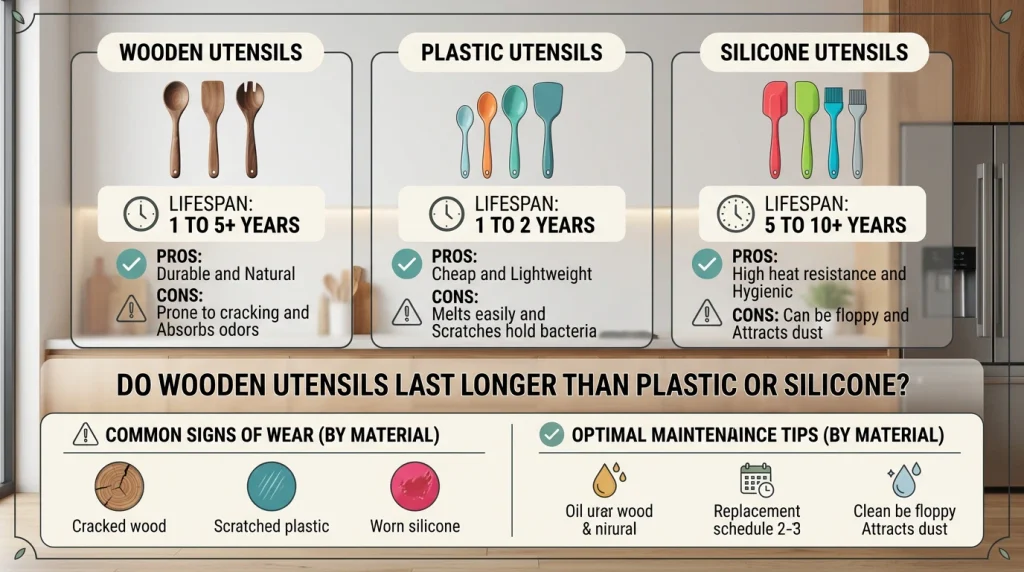
Often, yes, but it isn’t a guarantee. One editorial guide suggests replacing wooden spoons about every five years and rubber spatulas about every two, which implies wood can outlast softer materials if cared for.
Silicone has its own strengths, including heat tolerance and easy cleaning, and it doesn’t crack the same way. If you want a closer side-by-side, see how wood stacks up against silicone in a separate comparison. The better choice depends on the job and on how much care you’re willing to give.
Do Wooden Cooking Utensils Scratch Pans?
Generally no. Wood is softer than metal cookware, and care guides commonly note that wooden spoons won’t damage pots or nonstick coatings, which is one of the main reasons people keep reaching for them.
That said, a rough, splintered edge or a piece of hard grit stuck to the spoon could still mark a delicate surface. Keeping the wood smooth is a good habit for both your pans and your utensils.
Are Wooden Spoons Better Than Plastic?
It depends on what you mean by better. For pan-friendliness and long life with good care, wood does well. For simple maintenance, plastic and silicone are easier because they can usually go in the dishwasher.
On hygiene, the evidence isn’t one-sided, which the next section explains. In short, neither material is automatically safer. How well you clean, dry and replace the tool matters more than the label on it.
Do Bacteria Get Trapped in Wooden Spoons?
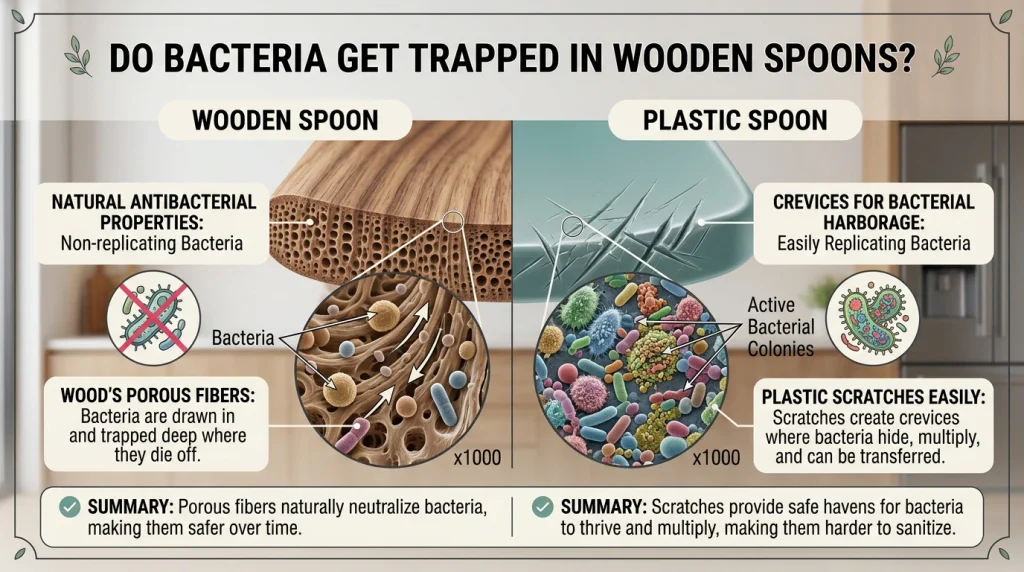
They can, in the sense that wood is porous and moisture and food particles can move into it. Whether that is a problem depends on how clean the spoon is, how well it dries and whether it has cracks or grooves.
If you want the broader safety picture, here is a separate guide on whether wooden spoons are safe for everyday cooking. The short version below sticks to what lifespan-related research and guidance say.
What the Research Says
Most of the well-known research is on wooden cutting boards, not spoons. Food microbiologist Dean Cliver and colleagues reported in the 1990s that bacteria were harder to recover from wood than from plastic, because they appeared to be drawn into the wood rather than staying on top.
Experts quoted by Discover Magazine conclude that either wood or plastic is fine if kept clean. Because that work was done on cutting boards, applying it to spoons is reasoning by analogy, so treat it as reassuring but not conclusive.
Why Cleaning and Drying Still Matter
Even if wood handles bacteria well, you should still wash it and let it dry fully. A food-safety researcher quoted by Tasting Table said wood copes best when it dries in a space with good airflow, sometimes for up to a day.
Cracks and deep grooves are the real worry, because they are hard to scrub. That’s also why the USDA tells people to replace worn or grooved cutting boards, and the same sensible rule applies to a badly cracked spoon.
How to Make Wooden Cooking Utensils Last Longer
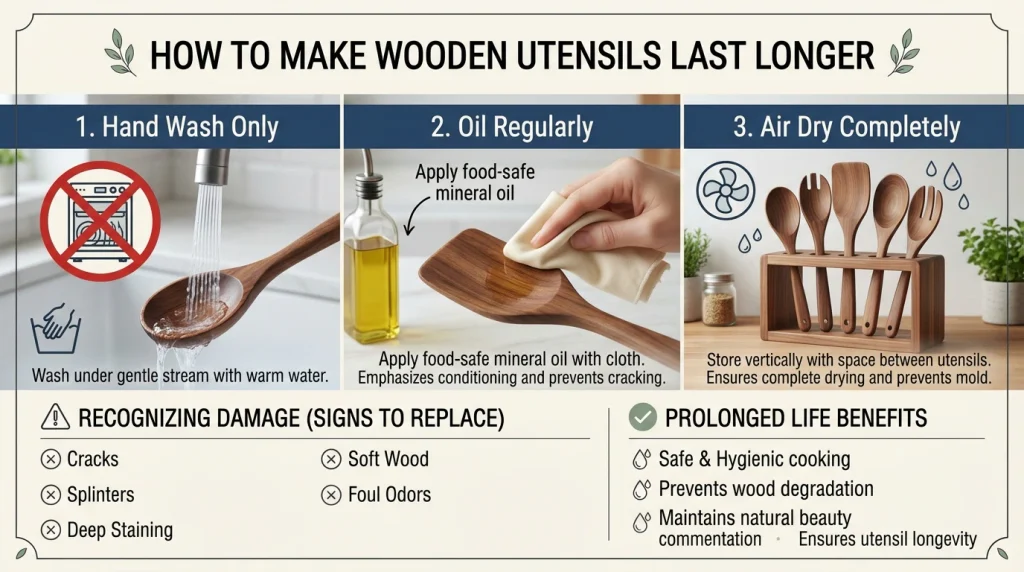
You can’t make wood last forever, but you can avoid the habits that shorten its life. None of this takes much time, and most of it is about water and heat.
Wash, Dry and Store Them Properly
Wash wooden utensils by hand with mild soap and warm water soon after cooking, never soak them, and keep them out of the dishwasher. Pat them dry, then let them air dry fully before putting them away.
Store them somewhere with airflow, such as an open crock, instead of a damp drawer. For a step-by-step method, see this gentle hand-washing routine for wooden kitchen tools.
Do Wooden Cooking Utensils Need to Be Oiled?
Most care guides say yes, occasionally, using food-grade mineral oil when the wood looks dry, dull or rough. Cooking oils like olive or vegetable oil are usually discouraged because they can turn rancid.
Oiling isn’t strictly required to keep a spoon usable, and plenty of home cooks report cheap spoons lasting years with little care, but those are anecdotes, not data. Guides also disagree on how often, from every few weeks to a couple of times a year. For a deeper walk-through on stopping splits before they start, see our dedicated guide.
When to Throw Away Wooden Utensils
A wooden utensil doesn’t suddenly expire. It shows signs first, and learning to read them is more useful than counting years. Some of those signs are about safety, and some are only about looks or taste, so it helps to know which is which before you bin a spoon you actually like.
Signs Wooden Cooking Utensils Need Replacement
Replace a wooden spoon or spatula if it has deep cracks, splinters, soft or spongy patches, or black spots that look like mold. Several consumer guides also list persistent odors and stains that won’t come out as reasons to retire it, though those are more about taste and looks than safety.
Normal dryness isn’t a reason to throw one away. One guide notes that a slightly dry spoon can often be revived with oil. Deep structural damage is different, because it can’t be repaired.
How Long Do Wooden Cooking Utensils Last Once Cracks Appear?
Once a crack is deep enough to catch food or to widen with every wash, the spoon is on borrowed time. There is no tested timeframe, so the safest approach is to replace it soon instead of waiting for it to break into your pot.
A tiny hairline mark on the surface is less urgent than a split that runs through the handle or head. Use your judgment: if you can’t get it clean, it has done its job.
Is It Safe to Use Old Wooden Cooking Utensils?
If the utensil is smooth, solid, clean and free of cracks, mold and lingering smells, age by itself isn’t a safety problem. If it’s splintered, soft or visibly moldy, it should go.
The closest official guidance is the USDA’s advice that heavily worn or grooved boards should be replaced because the grooves are hard to clean; see the USDA food safety guidance on worn cutting boards. It’s written for cutting boards, so it’s an analogy, not a rule for spoons.
Can Wooden Spoons Last a Lifetime?
Some can last a very long time, especially well-made ones that are used lightly and cared for. One care guide even says that a spoon used, stored and cleaned with care can last a lifetime, though that is a claim, not a promise.
For everyday cooks, a more realistic goal is many years rather than forever. Keep an eye on condition, and don’t feel guilty about replacing a tool that has done a decade of work.
A Simple Care and Replacement Checklist
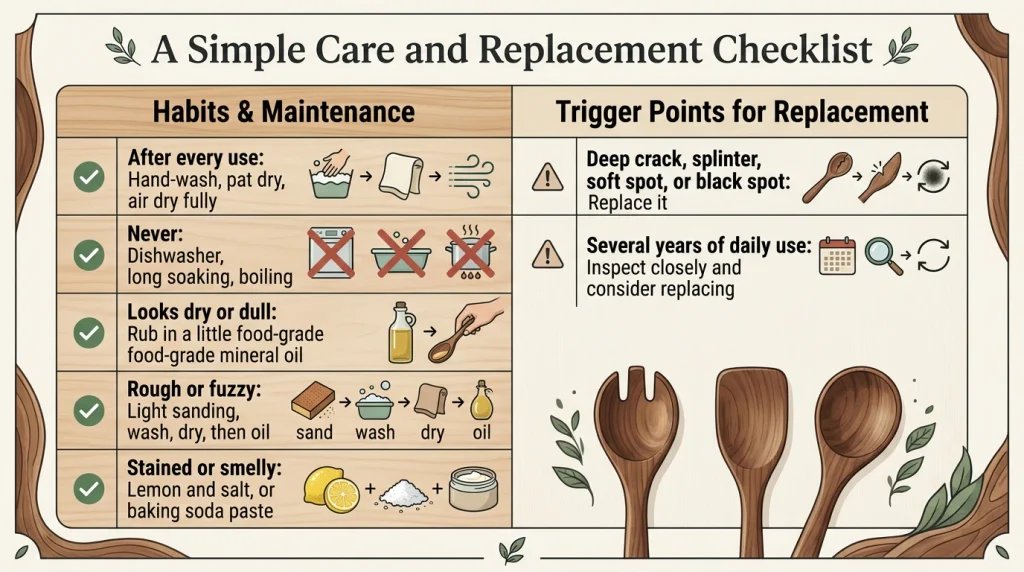
If all of the above feels like a lot, this table boils it down into habits and trigger points you can follow without thinking.
| Situation | What to do |
| After every use | Hand-wash, pat dry, air dry fully |
| Never | Dishwasher, long soaking, boiling |
| Looks dry or dull | Rub in a little food-grade mineral oil |
| Rough or fuzzy | Light sanding, wash, dry, then oil |
| Stained or smelly | Lemon and salt, or a baking soda paste |
| Deep crack, splinter, soft spot or black spot | Replace it |
| Several years of daily use | Inspect closely and consider replacing |
FAQs
Here are two quick answers to questions that come up a lot, in case you skipped straight to the end. Each one points back to the longer explanations above if you want the reasoning behind the advice.
How Do I Maintain My Wooden Spoons?
Wash them by hand with mild soap, dry them well and let them air dry. Oil them with food-grade mineral oil when they look dry, store them with airflow, and replace them when they crack, splinter or show mold. Avoid the dishwasher and soaking.
Are Expensive Wooden Utensils More Durable?
Not necessarily. I found no reliable testing that links price to lifespan. A higher price might mean better hardwood, smoother finishing and more careful construction, but it doesn’t replace proper care, and a cheap spoon that’s well treated can outlast a pricey one that’s soaked.
Final Thoughts
So, how long do wooden cooking utensils last? Somewhere between a couple of years and many years, depending on use, wood quality and care. The most common rule of thumb is about five years, but your spoon’s condition is a better guide than the calendar.
Wash gently, dry fully, oil when needed, and retire any tool that is cracked, soft or moldy. Do that, and a good wooden spoon will keep earning its place in your kitchen for a long time.