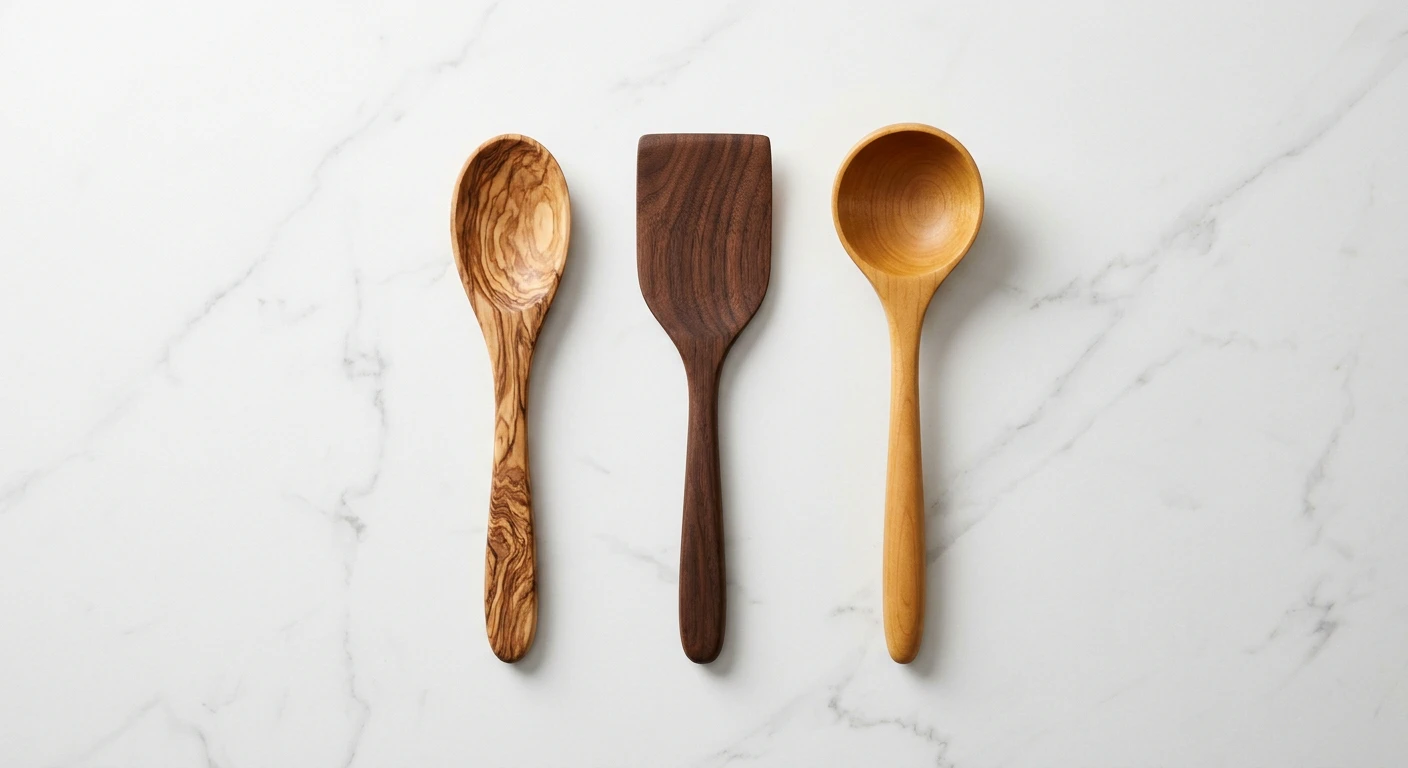
The best wood for kitchen utensils is usually a plain, closed-grain hardwood such as beech, maple or cherry, finished only with something the maker states is intended for food contact. No single species wins for every kitchen, though. Hardness, grain, finish, allergies and how you wash your utensils all matter as much as the tree name. This guide compares the woods most often used for spoons, spatulas and ladles, shows where the evidence is solid and where it is thin, and gives you a checklist for choosing.
For the wider picture, see our article on the benefits of wooden kitchen utensils and our balanced look at wooden kitchenware advantages and disadvantages.
What Is the Best Wood for Kitchen Utensils?
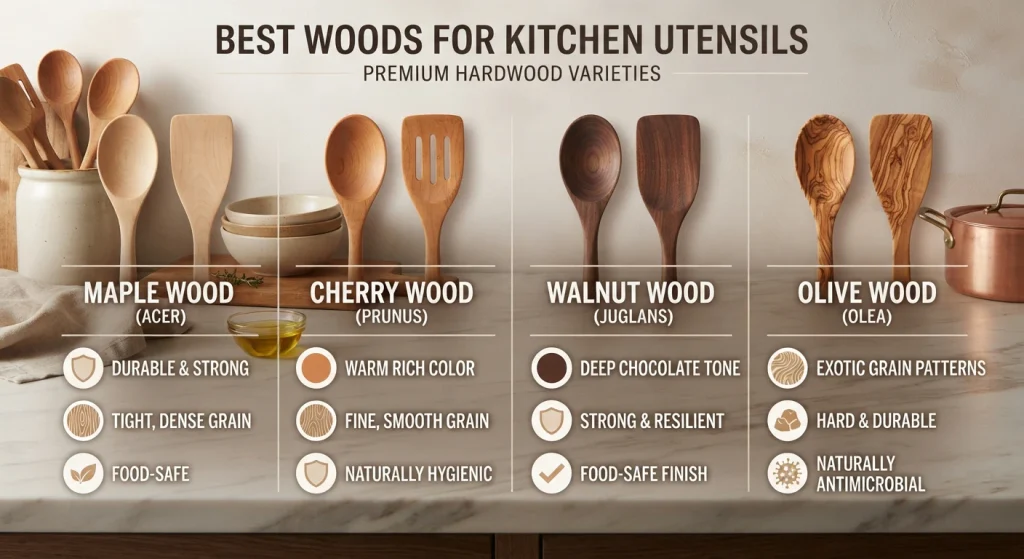
For most home cooks, choose a single-species, closed-grain hardwood with a smooth, plain finish. Beech, hard maple and cherry are the woods most often recommended in woodworking and kitchen guides. Walnut is also common.
Two honest limits apply:
- Much of the “best wood” advice online comes from woodworking and cutting-board guides and retailers. It reflects convention, not a regulatory ranking of utensil woods.
- Official food-safety guidance we found covers cutting boards. It says either wood or a nonporous surface can be used, and that worn boards with hard-to-clean grooves should be replaced. [USDA FSIS] It does not name a “safest” species.
If a seller cannot tell you the wood species and what finish was used, treat that as a reason to look elsewhere.
How to Choose the Best Wood for Kitchen Utensils
Grain and pores
Woodworking guides recommend tight, closed-grain woods for food contact. Large pores in open-grain woods can hold moisture and food particles, and open-grain wood can shed small splinters. [Kreg; Bob Vila] This advice is written mainly for cutting boards, so apply it to utensils as a sensible rule rather than a tested standard.
Hardness (and what the Janka number does not tell you)
The Janka test measures the force needed to press a steel ball into the wood. It shows resistance to denting. It does not measure food safety, cracking tendency or how a wood behaves in hot water. Janka hardness test.
| Wood | Typical Janka (lbf) | Practical note for utensils |
| Hard maple | about 1,450 | Fine grain; the usual benchmark in board guides |
| American beech | about 1,300 | Similar performance to maple, often cheaper |
| Teak | about 1,155 | Oily; silica dulls tools; sensitizer reported |
| Black walnut | about 1,010 | Darker; moderate hardness |
| Cherry | about 995 | Moderate hardness; oils may be needed more often per one retailer guide |
| Sheesham (Dalbergia sissoo) | about 1,660 (one retailer) | CITES-listed; skin irritation reported |
| Acacia | about 1,700–2,300, varies by species | “Acacia” covers many species; see below |
| Olive | about 2,700 | Very hard; high movement in service |
Values come from the sources listed at the end. Different sources give slightly different figures, so use them as rough comparisons only. Higher is not automatically better. A very hard spoon is not necessarily safer or kinder to your pan.
Finish, glue and the maker’s food-contact information
A food-safe wood can be made unsuitable by a coating or adhesive. Ask what finish was used and whether the maker states it is intended for food contact. Do not assume a glossy or varnished finish is safe for food. Food-grade mineral oil and similar oils are the commonly cited care products for wooden spoons. [Apartment Therapy; Real Simple]
Species identity and allergies
Trade names are loose. A single trade name can cover several species, and tracking the source of a wood can be hard. [AAW] This matters because allergic and irritant reactions in the literature are tied to specific species, and most reports concern woodworkers exposed to dust, not people using a finished spoon.
Wood-by-Wood Comparison
Maple, beech and cherry
These are the conventional choices. They are closed-grain, moderately hard and widely used for spoons and boards. One cookware brand’s beechwood spoon is cited as a durable example in a consumer guide. [BestReviews] Cherry is slightly softer than maple and beech.
Walnut
Walnut is popular for its dark colour. People often ask whether walnut wood is a problem for tree-nut allergy. A paediatric allergist writing for Food Allergy Canada says the allergy is to nut protein, so walnut wood items are likely extremely low risk, and highly purified oils usually contain very little protein.
[Food Allergy Canada] An allergist answering for the Asthma and Allergy Foundation of America says touching walnut wood is not expected to pose a risk because the allergen in the tree pollen is not in the wood. [AAFA] If a family member has a diagnosed allergy, ask their allergist and avoid nut-oil finishes unless the allergist agrees.
Teak
Teak is widely used for outdoor furniture and is sometimes sold as kitchenware. Two cautions apply. First, its silica content dulls cutting edges, which matters mainly to the maker. Second, teak has been reported as a sensitizer, and a hazard database lists allergic contact dermatitis and asthma, mainly from wood dust in work settings.
[Haz-Map; Wood Database via bois-exotique] I did not find evidence on reactions from using a finished teak spoon, so the cautious wording is: possible, mostly documented for woodworkers, and worth knowing about if you have a history of wood allergies.
Acacia
“Acacia” is a large group of species, so general statements are risky. One species, Australian blackwood (Acacia melanoxylon), is documented as a cause of allergic contact dermatitis and asthma in woodworkers. [Hausen & Schmalle, Br J Ind Med; PubMed] That does not prove other acacia woods behave the same way, and it does not show a finished acacia spoon is a risk. It does show why the species name matters. Hardness also varies by species, so treat “acacia” as a label to ask about, not a guarantee.
Olive wood
Olive wood is very hard and attractive, and listed as a sensitizer in rare cases. [Wood Database via bois-exotique] A wood-reference site also describes high movement in service and poor stability, especially from branch wood, which can mean cracking or warping if the utensil is soaked or dried quickly. [ForestSource] Olive wood is a reasonable choice for serving spoons and display pieces if you can care for it carefully.
Sheesham (shisham) in Pakistan
Sheesham is Dalbergia sissoo, widely planted in Pakistan. [FAO] It is also a CITES-listed species, so ask about legal sourcing. [CITESwoodID] One retailer reference lists skin irritation as reported. [bois-exotique] I found no reliable source assessing sheesham utensils for food contact, so this article does not recommend or rule it out. Ask the maker about species, finish and food-contact suitability.
Is Teak or Acacia Better for Kitchen Utensils?
Neither is a clear winner on the evidence we found. Both are named in sensitizer literature in some form (teak as a species, acacia for one specific species), both vary by source and finish, and neither is the conventional default for spoons. If you must choose, pick the one with the clearer species name, a stated food-contact finish and a smooth, tight-grained surface, and compare it against plain beech or maple.
Is Bamboo Good for Cooking Utensils?
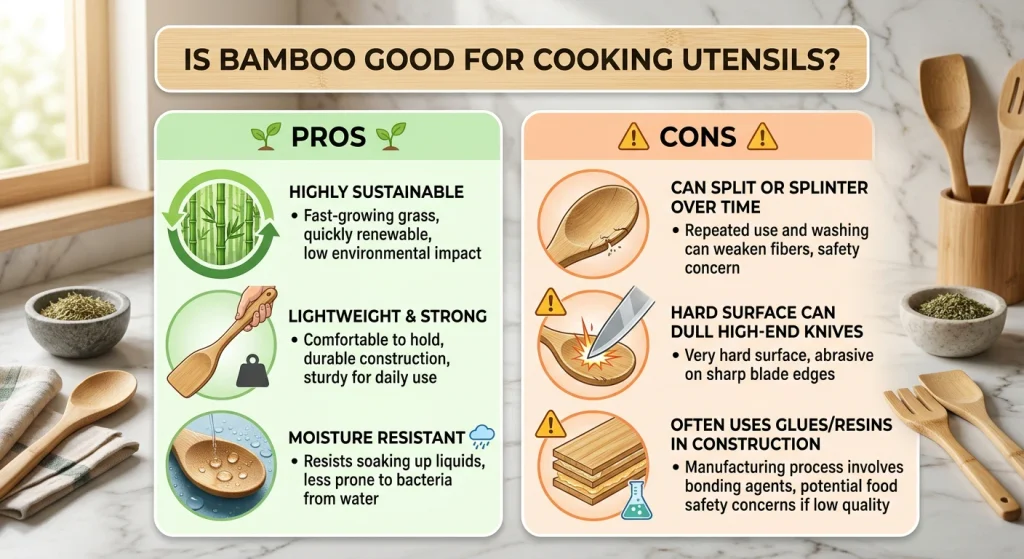
It depends on what the product actually is.
- Solid bamboo is described by USDA FSIS as harder and less porous than hardwoods for cutting boards. [USDA FSIS]
- “Bamboo ware” sold as cups, bowls and tableware often turns out to be melamine-formaldehyde resin with bamboo fibre filler. Germany’s BfR found that such products can release melamine and formaldehyde into hot food, and often more than conventional melamine items. [BfR; Food Packaging Forum] A UK expert committee agreed this is a potential concern. [UK COT]
So, for bamboo, check that the utensil is solid bamboo, not a fibre composite. The BfR findings concern fillable tableware used with hot contents, so they do not automatically apply to every bamboo spoon, but they show why the material must be identified.
What Wood Should Not Be Used for Spoons?
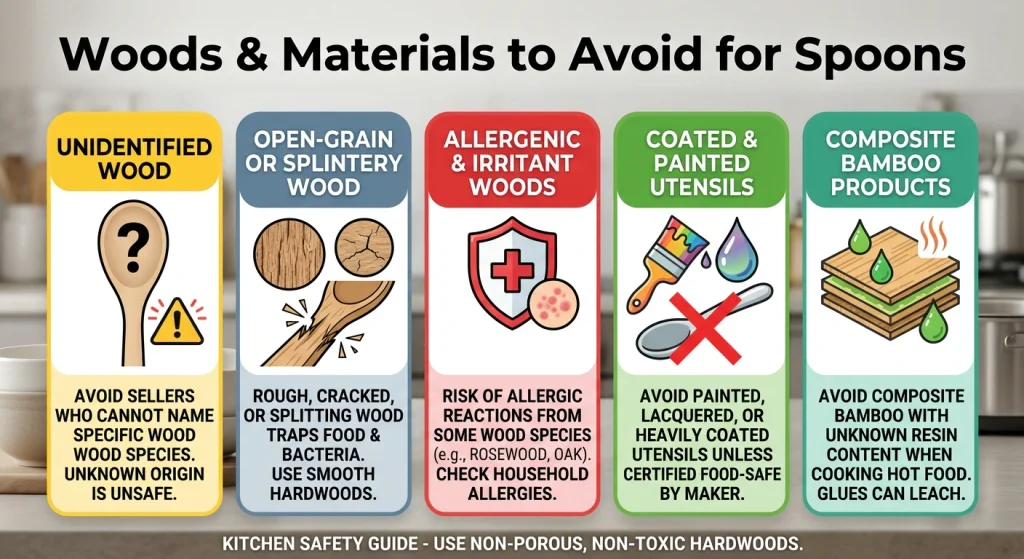
Avoid:
- Unidentified wood and any seller who cannot name the species.
- Open-grain or splintery wood that is rough, cracked or splitting.
- Woods with documented irritant or sensitizer concerns if you or someone in your home has wood or contact allergies (the species named above are examples, not a complete list).
- Painted, lacquered or heavily coated utensils unless the maker states the coating is intended for food contact.
- Composite “bamboo” products with unknown resin content, for hot food.
Several woodworking sources also advise never using potentially toxic woods for cutting boards, bowls or eating utensils. [Workshop Companion; Fine Woodworking]
Best Wood by Utensil Type
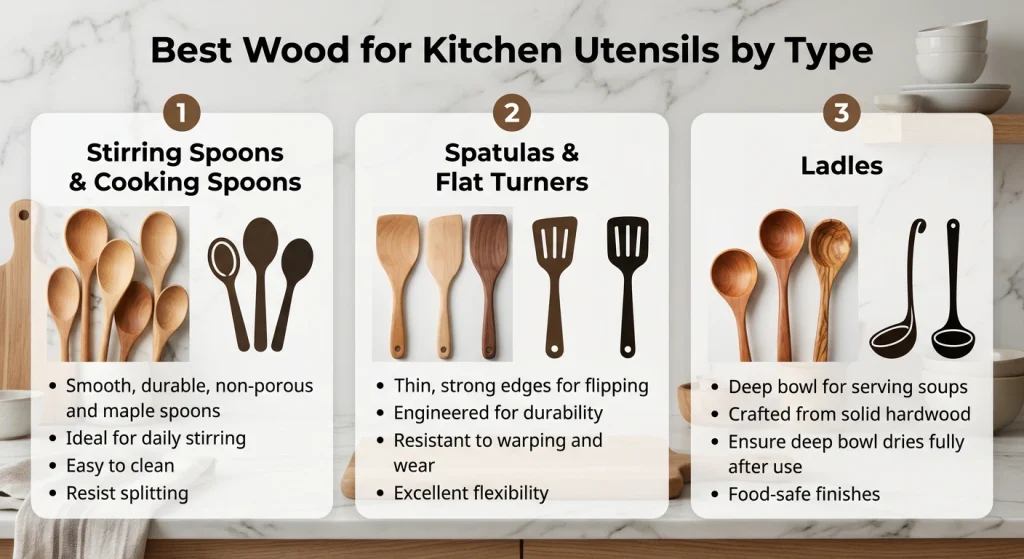
Best Wood for Kitchen Utensils by Type: Spoons, Spatulas and Ladles
- Stirring spoons and cooking spoons: beech, maple or cherry are the usual defaults. Choose a smooth bowl and handle with no cracks.
- Spatulas and flat turners: thinner edges wear faster, so a hard, tight-grained wood is a practical choice. Check the edge for splitting over time.
- Ladles: the deep bowl is the hardest part to dry. Make sure it dries fully between uses.
Best wood for kitchen utensils if you use nonstick pans
Wood is commonly described as gentle on nonstick surfaces and not prone to melting like plastic. [BestReviews; Real Simple] Pick a smooth-edged utensil and stop using any that has become rough or splintered.
Best wood for kitchen utensils with a nut allergy in the home
Allergists quoted above say the nut protein, not the wood, is the allergy concern, but this is general information. Ask your allergist, and be careful with nut-oil finishes.
Care Points That Affect How Long Wood Lasts
- Wash by hand soon after use, dry well, and avoid long soaking. Consumer guides advise against the dishwasher for wooden spoons. [Apartment Therapy; Real Simple]
- Condition occasionally with food-grade mineral oil if the wood looks dry. [Apartment Therapy; Real Simple]
- Note that USDA says solid-wood cutting boards can go in the dishwasher, but that is a different product. Follow the maker’s instructions for your utensil. [USDA FSIS]
- Replace utensils that are split, deeply grooved or hard to clean, in line with USDA’s advice for worn boards. [USDA FSIS]
For a full routine, see our guide to [types of wooden kitchen utensils]
Quick Questions
What wood is best for kitchen utensils? A plain, closed-grain hardwood such as beech, maple or cherry is the usual recommendation, with a clearly identified species and a stated food-contact finish.
Which wooden utensils are safe? Safety depends on species, finish, condition and care. Look for named wood, a smooth surface, no cracks and a maker who states the finish is intended for food contact.
Is walnut wood good for cooking utensils? It is commonly used. Allergists quoted above consider tree-nut allergy from the wood very unlikely, but check with your allergist if relevant.
Do professional chefs use wooden utensils? We found no reliable survey or source on this, so we make no claim either way.
What is the healthiest material for cooking utensils? We found no reliable source that ranks materials. See our comparison in [wooden kitchenware advantages and disadvantages]
Summary
The best wood for kitchen utensils is the one you can identify, with tight grain, a smooth surface and a finish the maker says is food-contact appropriate. Beech, maple and cherry are the conventional choices. Treat teak, acacia, olive and sheesham as options that need more questions about species and finish. Check that bamboo is solid, not a resin composite. And replace any utensil that has cracked or become hard to clean.

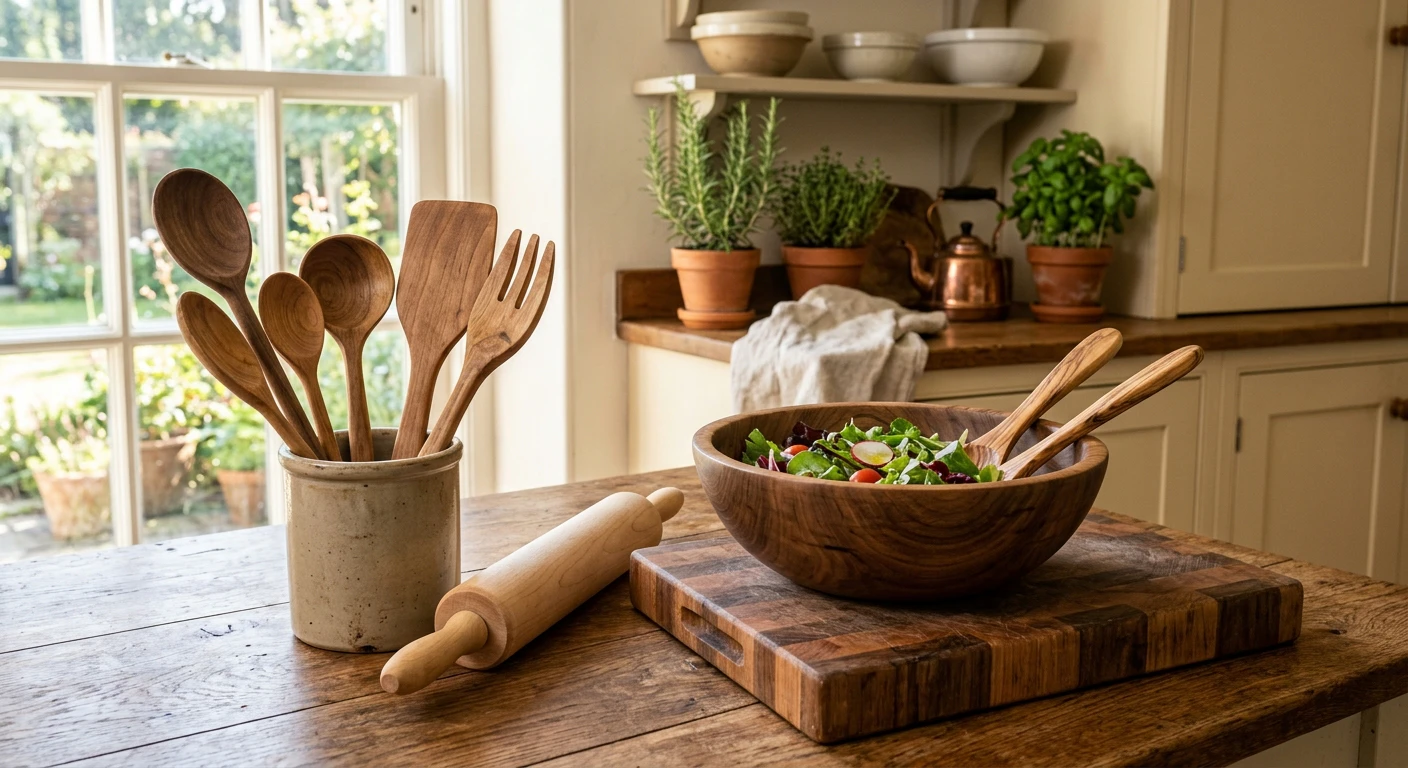
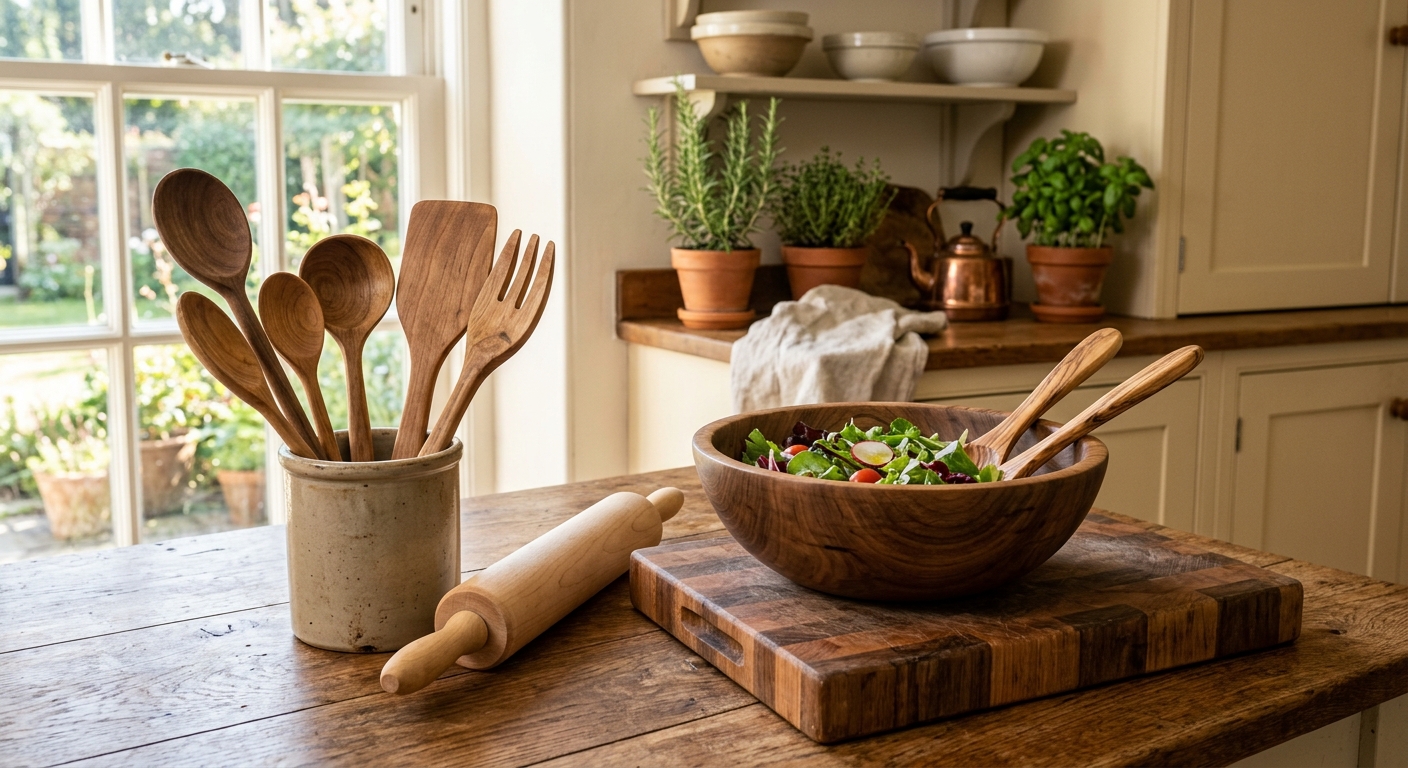
[…] Best Wood for Kitchen Utensils: How to Choose and What to Avoid […]
[…] than a selling point. For a closer look at which species suit spoons and ladles, our guide to the best wood for kitchen utensils compares the common […]
[…] the usual choice for spoons and boards because they hold up better to daily use. Our guide to the best wood for kitchen utensils compares the common options so you can pick with […]
[…] maple and beech as dependable picks. Olive wood is another favourite for spoons. Our guide to the best wood for kitchen utensils compares these woods one by […]
[…] ask which wood it is and look for even thickness with no cracks along the handle. Our guide to the best wood for kitchen utensils compares the common options. Beyond spoons, these are worth […]
[…] There is no official ranking. The Wisconsin cutting-board research tested nine hardwoods and reported broadly similar results across them, and the manufacturer overview above points to suitable hardwoods in general rather than a single winner. Maple is a commonly recommended choice. The best food-safe wood for kitchen utensils is a dense, tight-grained hardwood that is sold for kitchen use and has no unknown finish. We compare teak, beech, olive, acacia, and more in our guide to the best wood for kitchen utensils. […]
[…] food-safe finish, or no finish at all. If you want to compare species in detail, this breakdown of which hardwoods hold up best in a busy kitchen covers the […]
[…] you want spoons that shrug off water and wear, the wood matters too. Our guide to which hardwoods tolerate water and wear best explains what to look […]
[…] the species, which is one reason the wood you start with matters. If you’re still choosing, a comparison of popular spoon woods explains how the common options […]
[…] woods handle kitchen life differently, so it helps to know which wood types handle kitchen life well. For a simple buying checklist, see how to judge wooden kitchen products before you buy. Also check […]
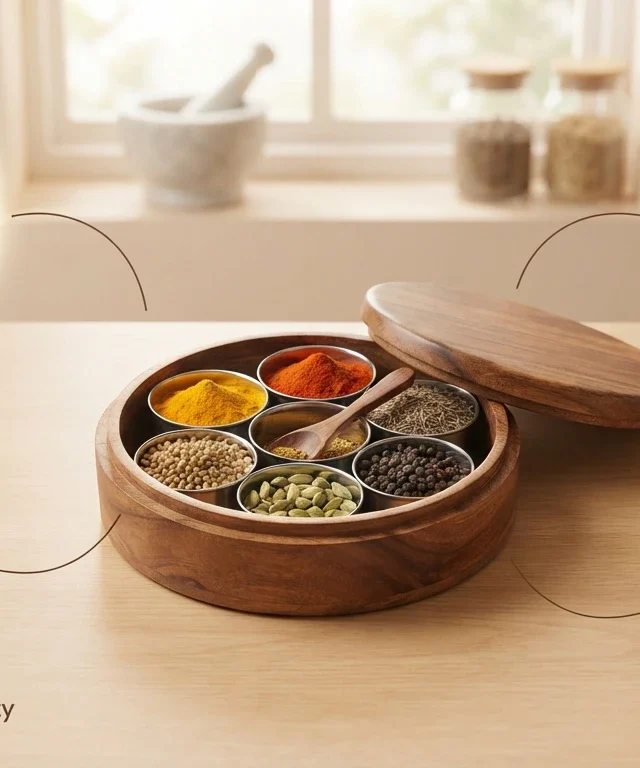
[…] it keeps light away from the spices inside. If you are not sure which type to pick, this guide on which woods are safest for food will help you […]
[…] sheesham or another local hardwood, ask which wood it is and how the box was finished. This page on which hardwoods work best in the kitchen explains more about common […]