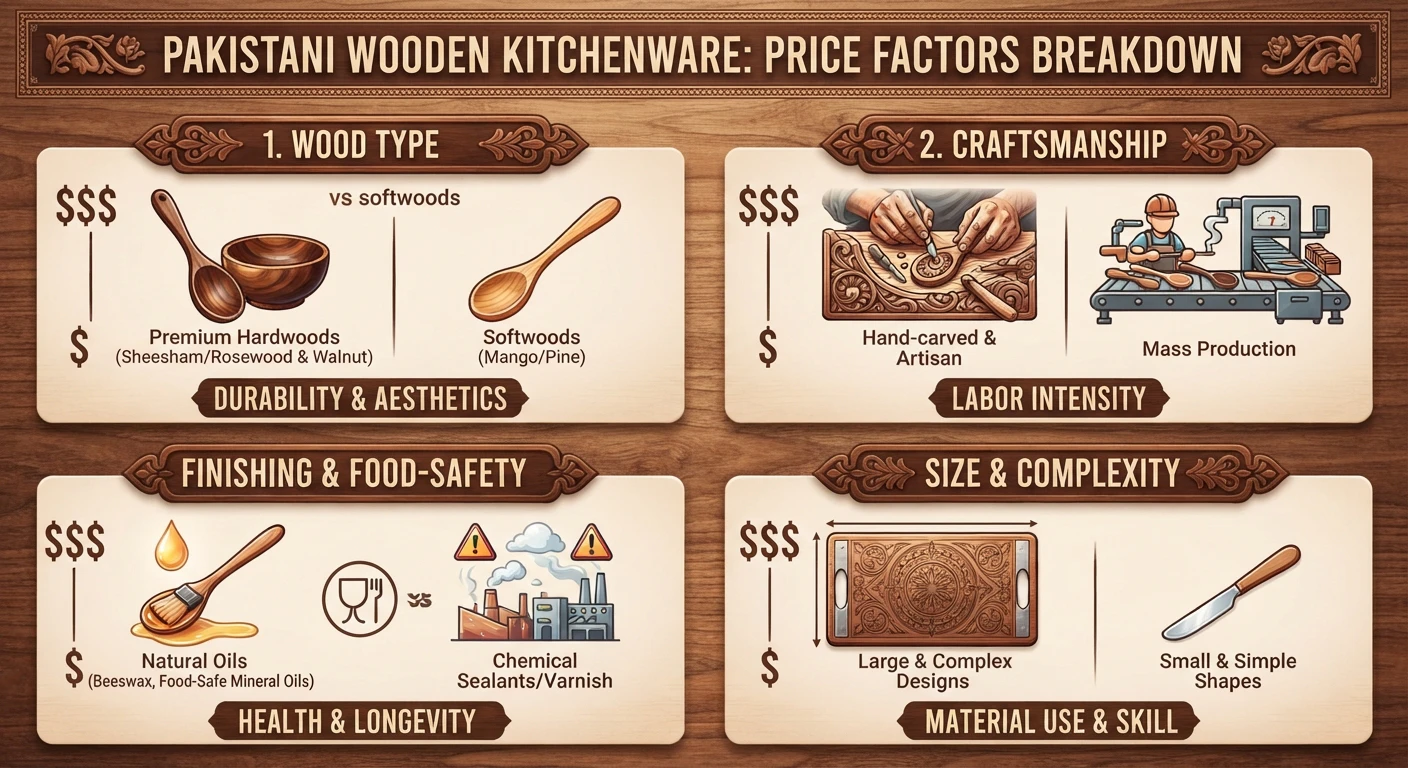
If you have ever stood in a shop in Lahore or scrolled through Daraz and wondered why one wooden spoon set costs far more than another that looks almost identical, you are not imagining things. The wooden kitchenware price factors in Pakistan come down to the wood itself, the hands that shaped it, the finish on top and the place you buy it from. This guide walks through each one in plain language so you can read a price tag with confidence.
We have deliberately not pinned exact rupee prices on every item. Wooden kitchenware prices move with timber costs, seller margins and sale campaigns, and any number printed here would be out of date quickly. Instead you get a way to judge whether a price makes sense today. Where safety comes up, the advice rests on published food-safety guidance and research, not on seller claims. If you are still deciding whether wood belongs in your kitchen at all, start with our guide to the benefits of wooden kitchen utensils and then come back here.
What Are the Main Wooden Kitchenware Price Factors in Pakistan?
The main wooden kitchenware price factors in Pakistan are the wood species, how well the timber was dried and cut, whether the piece is handmade or machine-made, the finish, the size and number of pieces, the brand, and the place you buy from. Origin and import costs can add to the total as well. Here is the short version before we go deeper:
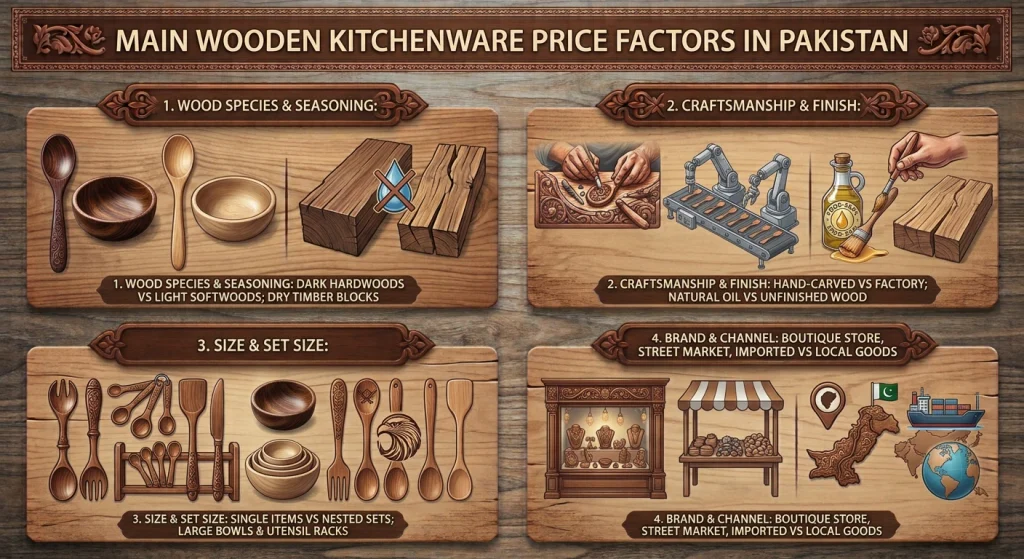
- Wood species: sets the starting cost and how hard the piece is to shape.
- Seasoning and grade: properly dried, clean timber costs more but is less likely to crack.
- Craftsmanship: hand-finished work takes more hours than machine-cut work.
- Finish: a food-contact finish and careful sanding add material and labour.
- Size and set size: bigger pieces use more wood, and sets bundle several tools.
- Brand and seller margin: packaging, reputation and after-sales service all sit inside the price.
- Sales channel: online marketplace, local shop or wholesale quote.
- Origin: locally made or imported.
None of these works alone. A plain spoon in a fine wood can cost more than a detailed spoon in a common wood, and a well-known brand may price above a small workshop for similar pieces. Reading a price properly means weighing all of these together, which is what the next sections help you do.
Why Wooden Kitchenware Price Factors in Pakistan Start With the Wood
Timber in Pakistan is usually priced per cubic foot, written as cft, and carpentry cost guides point out that the species you choose changes that rate noticeably. A spoon uses far less wood than a door or a cabinet, yet the species still sets the starting point, because a costlier timber makes every offcut and every spoon blank cut from it more expensive.
How Wood Type Affects Wooden Kitchenware Price Factors in Pakistan
Local sources list deodar (diyar), sheesham (tali), kail, kikar (acacia), partal and walnut among the woods people commonly deal with in Pakistan, and imported options such as ash and oak sit at the premium end of carpentry quotes. Walnut grows in northern areas like Swat, while deodar is best known as a construction timber. Sheesham turns up regularly in handmade spoon and spatula sets in seller listings.
Because the base price of each timber shifts with supply, grade and city, there is no single honest rate for “wood” in general. If a seller names the species, you can compare listings for that same species. If a listing only says “premium wood“, treat that as missing information rather than a selling point. For a closer look at which species suit spoons and ladles, our guide to the best wood for kitchen utensils compares the common options.
Wooden Kitchenware Price Factors in Pakistan: Local Wood vs Imported Wood
Locally made wooden kitchenware prices in Pakistan usually reflect local timber, local labour and local transport. Imported wooden kitchenware prices in Pakistan also carry shipping, customs duties and the importer’s margin. That does not make an imported piece better or worse. It means part of the price gap is logistics rather than quality, so judge each piece on its wood, finish and build, and ask where it was made.
How Timber Measurement Changes the Price You Are Quoted
When a maker or wholesaler quotes you a price per piece, the timber was most likely bought per cft, then cut into blanks, shaped and sanded. A good share of the wood is lost as shavings and offcuts, and that waste is built into what you pay. It is why a thin, simple spoon is rarely as cheap to produce as its size suggests.
Seasoning, Grade and Cut: Durability and Price Comparison
Wood that has been dried properly is less likely to warp or crack once it meets heat, water and daily washing. Drying takes time and storage space, and makers pass that cost on. A very low price can mean the wood was rushed, so look for hairline cracks near the bowl of a spoon or along the edge of a board.
Clear grain without large knots also holds up better, which is why a slightly higher price for clean, dry timber is often money well spent.
How Craftsmanship Changes the Price of Handmade Wooden Kitchenware
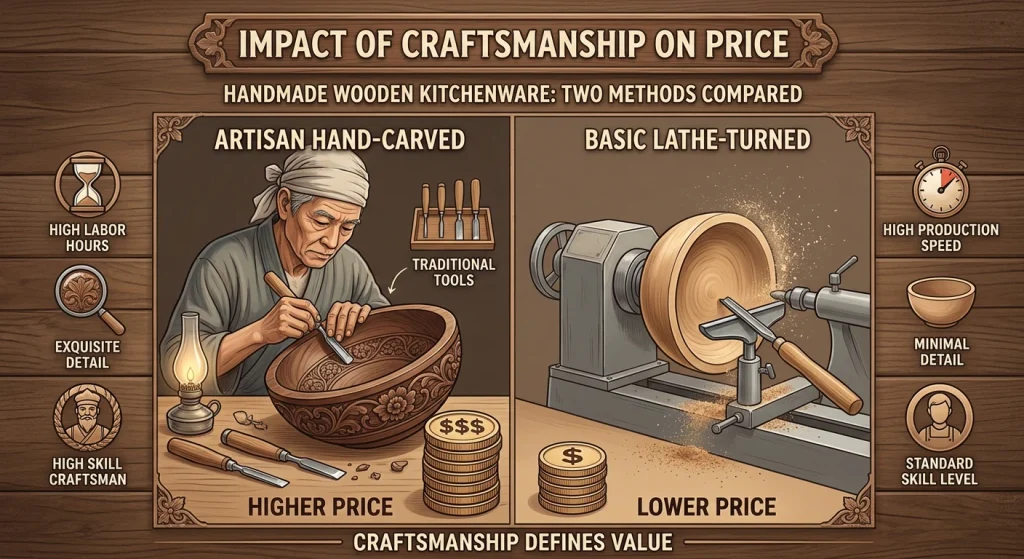
Craftsmanship is the factor people underestimate most. Two pieces cut from the same wood can sit at very different prices because of the hours, skill and quality checks that went into them. Understanding that difference helps you decide when a higher price is fair and when it is just a label.
Handmade vs Machine-Made Wooden Kitchenware
Handmade wooden kitchenware prices in Pakistan are generally higher because hand shaping, sanding through several grits and checking each curve takes hours that a machine run does not. Machine-made pieces cost less per unit because many are cut to the same pattern, yet a good machine-made spoon can still be smooth and well balanced.
Judge the object in your hand, not the word on the packaging. Beginners can find a gentler starting point in our wooden kitchenware for beginners guide.
How to Check Craftsmanship Before You Pay
You can test how craftsmanship affects wooden kitchenware prices without any special tools. Pick the piece up and run these quick checks:
- Slide your thumb along the edge and inside the bowl. It should feel smooth, with no splinters or rough patches.
- Look at the joint where the handle meets the head. There should be no gaps or glue lines on a spoon that is meant to be one piece.
- Check that the spatula edge is thin enough to slide under food.
- Hold it in your hand. The weight should feel balanced, not head-heavy.
A seller who is proud of the work will let you inspect it. If you are buying online, ask for close-up photos of the edges and underside.
How Finishing Affects Wooden Kitchenware Prices
Finish adds both material and labour. A bare, well-sanded piece is the simplest option. Oil or wax finishes cost a little more and make the wood easier to clean. Food-grade mineral oil is listed by the US Food and Drug Administration as a food additive, and a mix of mineral oil and beeswax is a popular choice among spoon and kitchenware makers, according to Fine Woodworking magazine. Glossy varnishes and coloured coatings cost more and raise more questions about food contact.
Food-Safe Wooden Kitchenware Price Factors in Pakistan: Claims to Question
“Food safe” on a listing is a claim made by the seller, not proof. A higher price for a food-safe finish is fair when the seller can name the oil or wax used. A vague claim is not worth extra. Brightly coloured sets are common in online listings, so ask what the colouring is made of. If nobody can answer, choose a plain oiled piece instead. Our guide to common wooden kitchenware mistakes covers other things people overlook.
Size and Set Size: Smaller Wooden Kitchenware Price Factors in Pakistan
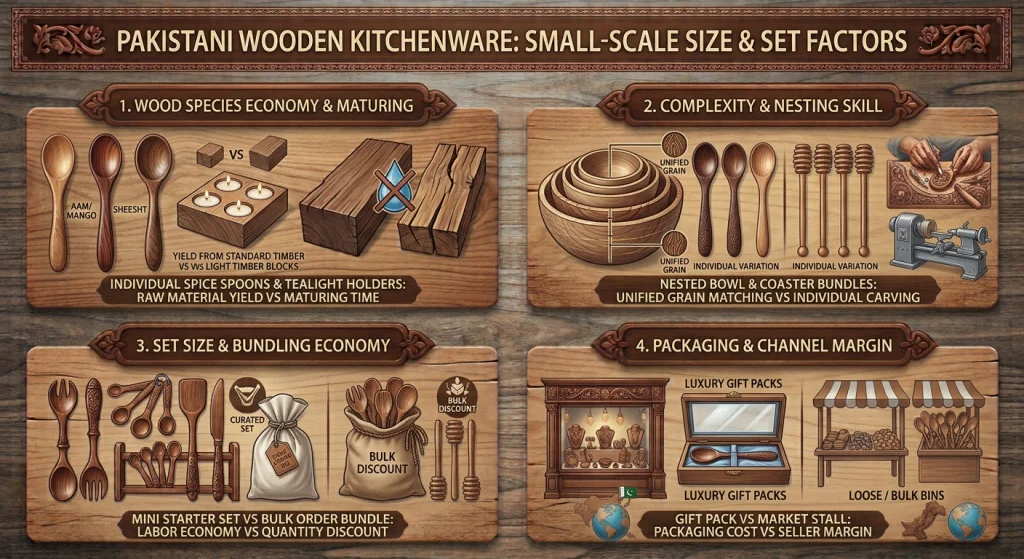
Size and piece count look like boring details, but they explain a lot of price gaps. A long ladle needs a bigger blank than a tasting spoon, and a seven-piece set simply contains more wood and more work than a two-piece one.
How Size Affects Wooden Kitchenware Prices
Larger pieces use more timber, take longer to sand and are harder to dry without cracking, so they usually cost more. This is why how size affects wooden kitchenware prices is most obvious with boards and rolling pins. A thick cutting board uses the most wood in the kitchen, and a thin, small one can be priced like a spoon. Before comparing two sets, compare their lengths, thickness and number of pieces so you are weighing like with like.
Spoons, Spatulas and Cutting Boards: Why Each Is Priced Differently
Wooden spoon price factors in Pakistan include length, bowl depth and how finely the bowl is carved. A wooden spatula with a thin working edge asks for more skill than a thick paddle. Wooden cutting board price factors in Pakistan lean on thickness, size and construction:
A board cut from one solid piece is treated differently from one made of glued strips. When you compare wooden spatula prices and quality, look at the edge and the handle joint. Our how to choose wooden kitchenware guide explains what to check on each item.
| Item | What mostly moves the price | What to check |
| Spoon | Length, bowl depth, wood species | Smooth bowl, no cracks |
| Spatula | Thin edge, wood species, handle shape | Edge thickness, balance |
| Cutting board | Size, thickness, solid or joined | Single piece, flat surface |
| Utensil set | Piece count, holder, finish | Price per piece |
Where You Buy Matters: Online, Local Markets and Wholesale
The same spoon can carry different prices depending on who sells it and how it reaches you. The seller’s costs, their margin and the buyer’s ability to inspect the piece all play a part. Our wooden kitchenware buying guide for Pakistan covers the shopping side in more detail, so here the focus stays on price.
Online and Shop Prices: Daraz, Lahore and Karachi
Marketplaces such as Daraz let many sellers list similar-looking sets, so wooden kitchenware online prices in Pakistan vary widely and photos can look alike. Read reviews, check the seller rating and confirm the species before you order. In a local market in Lahore or Karachi you can pick the piece up, smell it and check the finish, and the price depends on the shop’s costs and on how you negotiate. The Government of Punjab handicrafts portal lists woodwork from shops in Lahore, Bahawalpur and Islamabad with a price per piece, which is a handy reference for how handmade work is priced.
Wooden Kitchenware Wholesale Prices in Pakistan
Wholesale prices are lower per piece when you buy many, which suits gifts, weddings, small shops and restaurants. Many business listings for wooden spoons show “price on request” with a minimum order, so expect to ask for a quote rather than see a fixed rate. Ask what is included in the quote, such as finishing and packaging, and request a sample before placing a large order.
Why Prices Differ Between Brands
Wooden kitchenware price differences between brands in Pakistan come from packaging, branding, consistency of finish, return policy and customer support. A brand that checks every piece and replaces cracked ones is giving you something real for the extra money. A brand that only adds a logo is not. Always compare the specification, not the name.
What Is the Price of a Kitchen Set for Home in Pakistan?
There is no single price, because “kitchen set” can mean two different things. For a wooden utensil set, the price depends on the number of pieces, the wood, the craftsmanship and the finish. For kitchen woodwork such as cabinets, contractors may quote per square foot or per running foot, and a low rate may leave out hardware, polish and installation. Make sure you know which kind of set you are pricing.
For a utensil set, a simple way to compare is to divide the set price by the number of pieces and then adjust for wood, size and finish. A cheap 12-piece set made of unnamed wood is not automatically better value than a 6-piece set with a named species, a clear finish and well-shaped edges.
Cheap vs Expensive Wooden Kitchenware: Is Paying More Worth It?
Paying more is worth it when the extra money buys better wood, a cleaner finish and a sturdier build. It is not worth it when the extra buys packaging, a famous name or a “premium” label with no detail behind it. Cheap pieces can still be fine for light use, as long as they are smooth and made of a named wood.
Wooden Kitchenware Quality vs Price
When you weigh wooden kitchenware quality vs price, ask three questions: what wood is it, how was it finished and what happens if it cracks? If a seller answers all three clearly, a higher price is easier to justify. For a balanced view of what wooden tools do well and where they struggle, read our guide to the advantages and disadvantages of wooden kitchenware.
Maintenance and Long-Term Cost
Wooden kitchenware maintenance and long-term cost are small if you look after the pieces. Wash by hand with warm, soapy water soon after use, dry them standing up and avoid leaving them to soak. Add a little food-grade oil when the wood starts to look dry. A cheap piece that cracks and is replaced twice can end up costing more than one well-made piece, so count replacement cost, not just the first price.
Safety Checks That Matter at Any Price
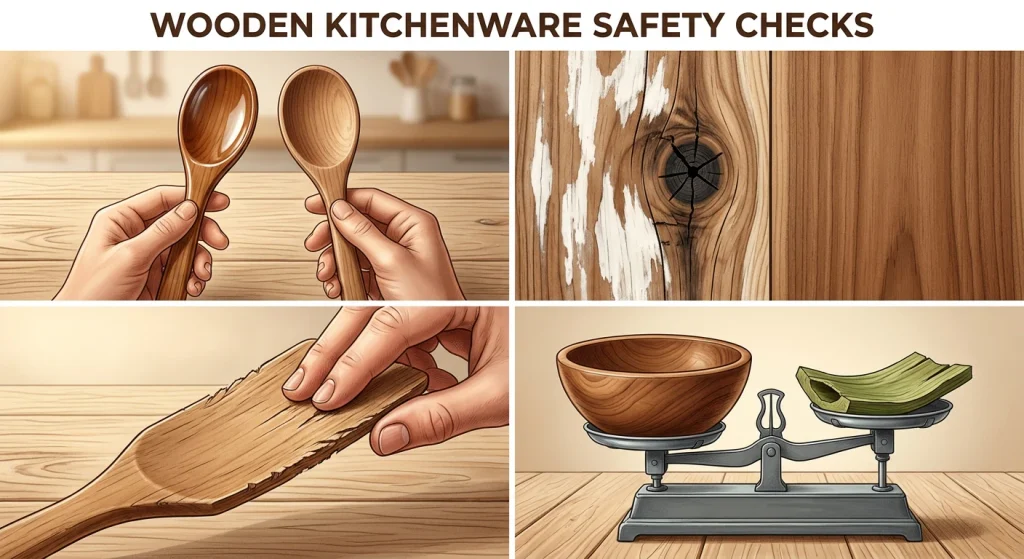
A higher price does not guarantee a safer product, and a lower price does not make wood unsafe. Food-safety extension guidance recommends choosing a cutting board made from a single solid piece of wood, replacing boards that develop deep grooves or cut marks, and using separate boards for raw meat and ready-to-eat foods, as explained in this university extension food-safety guidance.
Research points the same way. A 2025 laboratory study in the Journal of Food Protection found that maple boards reduced bacteria more than plastic boards and concluded that wood’s hygiene status deserves another look. Good cleaning and timely replacement matter more than the price you paid.
How to Plan a Wooden Kitchenware Budget in Pakistan
A budget plan keeps you from buying a large set you will never use. Start with what you cook, count the tools you reach for daily and put your money there first. Spend a little more on the items that touch hot food and your knife, and less on decorative extras.
Wooden Kitchenware Budget Planning for Beginners
Wooden kitchenware prices for beginners in Pakistan are easiest to manage with a short starter list: one stirring spoon, one flat spatula, one serving spoon and one small cutting board. Buy these first, use them for a few weeks and then add what you miss. Our wooden kitchenware for beginners guide has a longer starter list.
| Budget approach | Put your money into | Skip for now |
| Tight | One good spoon and spatula | Large sets, decorative pieces |
| Moderate | A named-wood set and one board | Extra serving pieces |
| Flexible | Handmade pieces with a clear finish | Anything with vague claims |
Affordable Wooden Kitchenware Price Factors in Pakistan: Where to Save
Affordable wooden kitchenware price factors in Pakistan usually come down to set size, decorative extras and packaging. You can save money by buying fewer pieces, skipping carved handles and avoiding gift boxes. Comparing three or four sellers for the same species and size helps too. A short checklist before paying also helps you avoid overspending on features you will never use.
Where Not to Save Money
Do not save on finish disclosure, smooth edges or, for cutting boards, a solid single-piece build. These are the places where a very low price is most likely to hide a shortcut. If you have decided to buy, the step-by-step Pakistan buying checklist will help you finish the job.
FAQs About Wooden Kitchenware Price Factors in Pakistan
These are the questions readers ask most often about what determines the price of wooden kitchenware in Pakistan. Each answer is kept short and direct, so you can scan for the one you need and move on to your shopping.
What are the wood prices in Pakistan?
Timber in Pakistan is quoted per cubic foot and changes with species, grade, city and season. Published rates age quickly, so ask a local timber dealer for today’s price for the species you want. Raw timber price is not the same as the price of a spoon or board, because shaping, finishing and waste are added on top.
What should I look for when buying wooden cooking utensils?
Look for a named wood, a smooth finish with no splinters, no hairline cracks, a sensible size for your pots and a seller who can say what finish was used. For boards, prefer a single solid piece. Compare price per piece rather than the total on the box.
What are some good wooden kitchen items?
Wooden spoons, spatulas, ladles and cutting boards are the usual starters. A chakla and belan for rotis, a serving spoon and a small spice scoop are also useful. Choose the items you will use every day before buying decorative pieces.
What is the price difference between bamboo and wooden kitchenware in Pakistan?
We could not find a reliable market-wide comparison, so there is no honest single figure to quote. Bamboo is a grass rather than a wood, and prices for both vary with size, finish and brand. Compare similar items by size and price per piece instead of assuming one is cheaper.
Final Thoughts on Wooden Kitchenware Price Factors in Pakistan
Wooden kitchenware price factors in Pakistan are easier to read once you separate the wood, the work, the finish and the seller. Ask for the species, inspect the edges, check the finish and compare price per piece. A fair price is one you can explain, and a good seller will help you do that. Start small, look after your pieces and add more only when you need them.

[…] size, finish and handwork all move the price, and our guide to wooden kitchenware price factors in Pakistan explains each one. When a seller asks for more, the extra should show up in something you can see, […]
[…] finishing it needed, whether it’s sold singly or as a set, and where you buy it. Our article on wooden kitchenware price factors in Pakistan breaks down each factor so you can judge whether a price makes […]
[…] food contact. Price often reflects wood quality and finishing, which we break down in our guide to wooden kitchenware price factors in Pakistan, and a very cheap, glossy spoon with no information about its finish is worth a second look. If you […]
[…] in Pakistan, our wooden kitchenware buying guide for Pakistan walks through what to look for, the price factors for wooden kitchenware in Pakistan explain why costs vary, and our roundup of top wooden kitchen accessories brands in Pakistan is a […]
[…] buying wooden kitchen items in Pakistan to know what to look for in shops and online. To understand what makes wooden products cost more or less, compare the wood type, size, finish and handwork between sellers, and ask for the material in […]