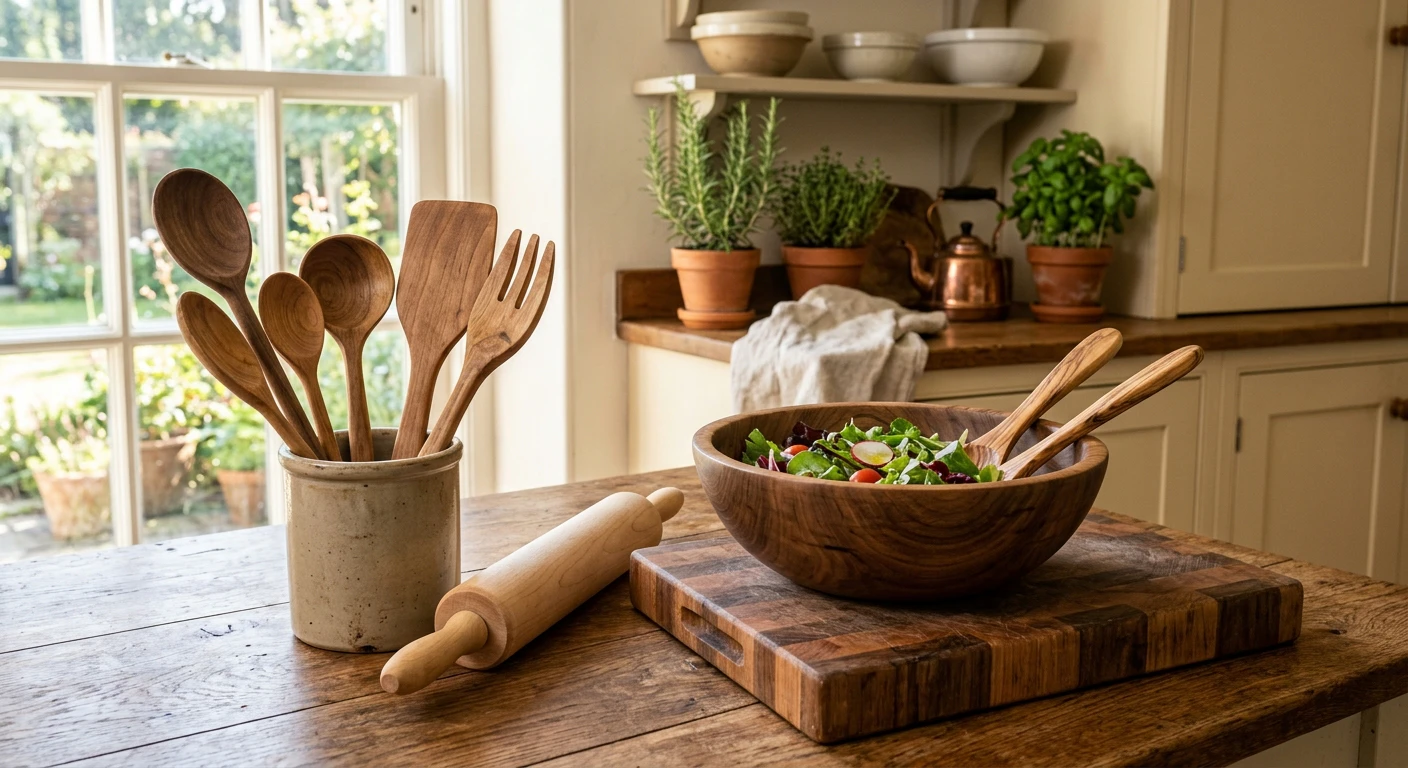
How to choose wooden kitchenware comes down to four checks: the condition of the wood, how the piece is joined and finished, whether its shape suits the job, and whether it suits your cookware. Pick pieces that are smooth and free of cracks, ask what finish was used, and match each tool to how you actually cook. No single wood or brand is best for every kitchen.
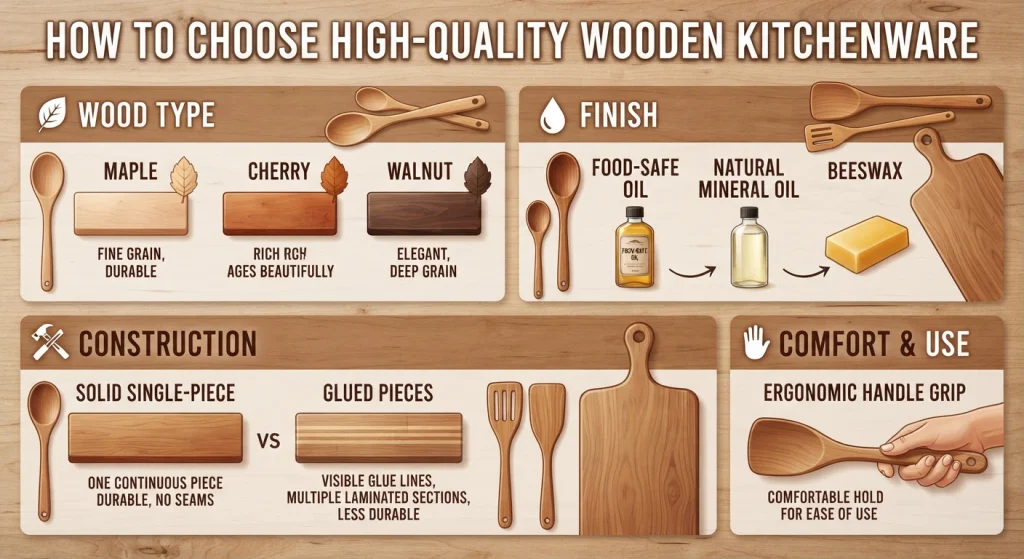
This guide covers what to inspect, how to think about wood types, how wood compares with stainless steel, and the mistakes that lead to a utensil you stop using. It does not rank products or recommend a brand. If you are still deciding which tools you need, start with our guide to the [types of wooden kitchen utensils.
How to choose wooden kitchenware
- Match the piece to the job. A spoon, a turner, a ladle and a belan do different work. Buy for what you cook.
- Inspect the surface. It should feel smooth, with no cracks, splinters or rough patches.
- Check the construction. A solid single piece has fewer places for moisture to collect than a glued or joined one.
- Ask about the wood and the finish. If the seller cannot say what was used, treat that as unknown.
- Check it suits your cookware. Nonstick pans, stainless steel and cast iron have different needs.
- Read the care instructions. Be ready to wash by hand and dry well.
- Compare price last. A low price is not a fault in itself, and a high price does not prove better wood or finish. The checks above tell you more.
What should you look for when buying wooden utensils?
Look at four things: the surface, the construction, the finish, and the maker’s care instructions. Each is easy to check in a shop and most can be checked from clear photos and a product description.
Surface, shape and weight
Run a finger along the bowl, edge and handle. It should feel even. Which? advises replacing wooden spoons, boards and rolling pins once they show deep cracks, splintering or persistent smells, so there is little reason to buy a piece that already shows them.
Shape matters as much as material. A deeper bowl carries more and a shallower one is easier for tasting. A thin edge suits sliding under food but can chip. One food brand’s blog notes that wood can break under thick, heavy mixtures, so for stiff doughs look closely at handle thickness. That is a brand’s opinion, not a test result.
Joins, handles and non-wood parts
Many utensils combine a wooden handle with a steel or other head. They can suit you, but a join can trap moisture and makers often give specific washing instructions. Check those instructions rather than assuming all-wood rules apply.
If a piece is glued or laminated, ask what adhesive was used. One manufacturer blog warns that reclaimed or treated wood may carry residues from paints, varnishes or adhesives. It cites no testing, so treat that as a reason to ask questions, not as an established finding.
Finish and care instructions
Mineral oil and beeswax are commonly used on wooden kitchenware. Which? recommends food-grade mineral oil rather than cooking oils such as olive oil, which can leave utensils sticky. A finished piece should come with care instructions. If it does not, that tells you something about the seller.
What “food safe” does and does not tell you
“Food safe” on a label is the seller’s claim. Whether it is true depends on the finish, whether it has fully cured, and what the piece is meant for. Retail guidance says a finish must cure, which takes longer than drying. Woodworking experts also disagree about how to judge many finishes. Do not assume ordinary varnish is suitable for food contact just because it feels dry. Ask what finish was used and whether the maker states it is intended for food contact.
Which wood is best for wooden utensils?
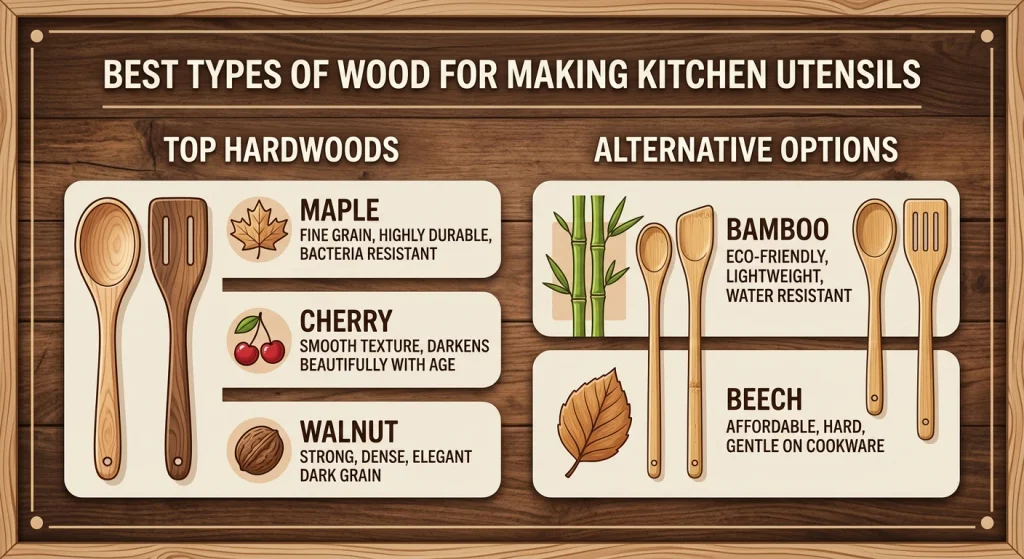
There is no single proven best wood. The consistent advice is to choose a hard, close-grained wood and avoid resinous softwoods. Beyond that, the finish, the condition and how well you dry the utensil matter at least as much as the species.
Two points of evidence help. First, Minnesota’s food-establishment rules allow “hard maple or an equivalently hard, close-grained wood” for items including cutting boards and utensils. That is a rule for commercial kitchens in one US state, not a home standard and not a ranking of species. Second, NC State food safety researcher Ben Chapman has said that fine-grained hardwoods such as maple draw liquid in and trap bacteria, while soft woods such as cypress pose a greater food safety risk. His comments were about cutting boards, so they are indirect evidence for spoons and spatulas.
Which wood is best for cooking food?
Cooking adds heat, so check how a wood behaves near a pan. Wood conducts heat poorly, so a wooden spoon left in a hot pot stays cool to the touch. One manufacturer blog warns that pine and cedar may release resins or odours when heated. It cites no testing, so treat it as a caution. A hardwood with a stated finish is the safer starting point than a resinous softwood.
The main food safety concern Chapman names for wooden utensils is not drying them properly. Whatever the species, plan to wash by hand and let the piece dry with good airflow.
Woods you will see, and what the evidence says
| Wood | What sources say | What is not verified here |
| Maple | Named in Minnesota’s rule as a permitted hard, close-grained wood for utensils | Not a ranking over other hardwoods |
| Beech | Wood Explorer describes an even texture, close grain and an excellent finish, and lists turnery and woodenware. Major retailers sell solid beech utensils | The page does not discuss food contact |
| Teak | Queensland government data describes an oily, greasy feel and silica that blunts cutting edges | No food-contact statement on that page |
| Acacia | Only low-authority blogs make claims about hardness and moisture resistance | Treat hardness and “natural oils” claims as unverified |
| Sheesham and mango | Common names in Pakistan-market listings | Not researched for this article. See the wood types guide |
| Pine, cedar and other softwoods | Chapman and one manufacturer blog caution against soft or resinous woods | Blog caution is untested |
How to choose wooden kitchenware when the seller does not name the wood
Ask four questions: what is the wood called (and, if possible, its botanical name, since local trade names vary), is it one solid piece, what finish was used, and what are the care instructions? If the seller cannot answer, you have unknown wood and an unknown finish. You can still buy it, but you cannot judge its suitability, so look for a piece whose maker states these details.
Which is better: wooden cooking utensils or stainless steel?
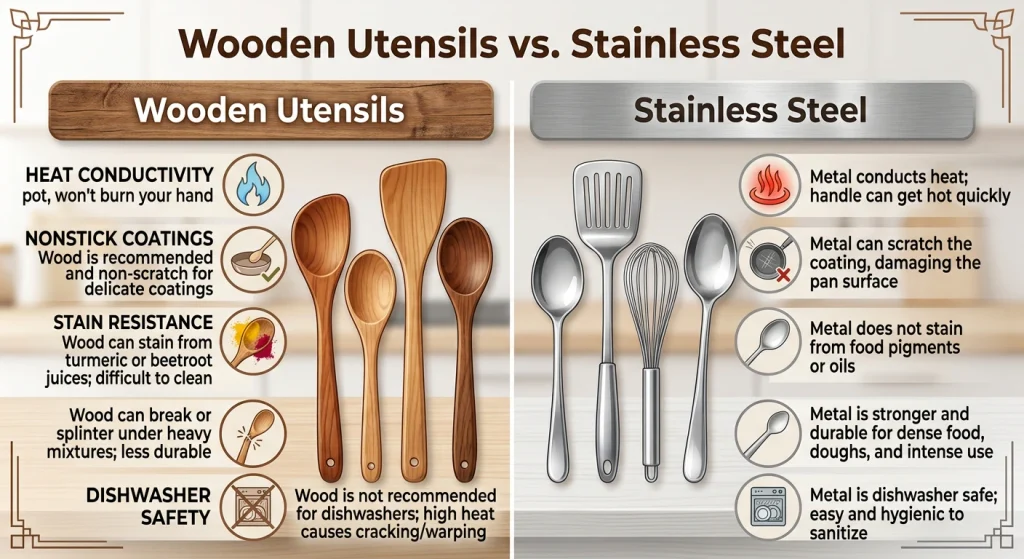
Neither wins on every point. The better choice depends on your cookware and the task.
| Factor | Wood | Stainless steel |
| Heat | Does not conduct heat much, so it stays cool in the pot | Conducts heat |
| Nonstick coatings | Recommended by cookware makers | Metal can scratch the coating, say cookware makers |
| Stainless or cast-iron pans | Will not scratch them | Cookware makers say metal is fine on stainless |
| Staining | Can stain, for example from turmeric or beetroot | Does not stain |
| Strength | Can break under thick, heavy mixtures | Described as stronger for dense food |
| Dishwasher | Which? advises against it | Check the maker’s instructions |
Evidence on hygiene is thin for utensils specifically. Which? says wooden spoons are hygienic if washed thoroughly between uses, and neither material is automatically safer. Condition, cleaning and drying matter more.
How to choose wooden kitchenware for your cookware
- Nonstick: Misen and Stellar both advise wood or silicone and warn that metal can scratch or strip the coating.
- Stainless steel: Stellar says metal, silicone and wood all work, and metal is fine for scraping or deglazing.
- Cast iron: One food brand notes that wood will not scratch cast iron or stainless pans.
Always check your cookware maker’s own guidance first, because it overrides general advice.
Is bamboo the same as wood?
No. Bamboo is a different material, and the distinction matters for safety. The UK Food Standards Agency advises against using plastic containers or utensils containing bamboo and other unauthorised plant-based materials, because formaldehyde and melamine can leak into food or drink above legal limits. Its advice does not cover items made solely from bamboo. When you see “bamboo fibre” on a label, ask whether it is solid bamboo or a bamboo-and-plastic composite. The FSA advice is for Great Britain, and I have not verified Pakistani standards.
Common mistakes when buying wooden kitchenware
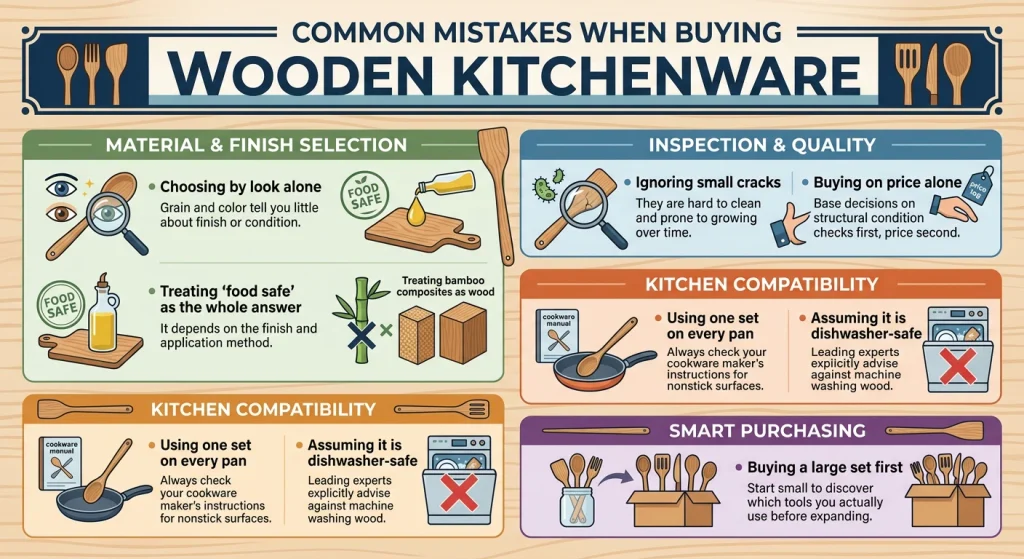
- Choosing by look alone. Grain and colour tell you little about finish or condition.
- Ignoring small cracks. They are harder to clean and tend to grow.
- Treating “food safe” as the whole answer. It depends on the finish and how it was applied.
- Using one set on every pan. Check your cookware maker’s advice for nonstick.
- Assuming it is dishwasher-safe. Which? advises against it.
- Treating bamboo composites as wood. They are different materials with different safety questions.
- Buying a large set first. Learn which tools you use, then add more.
- Buying on price alone. Use price after the condition checks, not instead of them.
Where to start if you are new to wooden kitchenware
Start with one general-purpose spoon and one turner, and add a ladle or belan only when your cooking needs it. If you are weighing whether wood is right for you at all, read the [benefits of wooden kitchen utensils] and the [wooden kitchenware advantages and disadvantages] side by side.
Care in brief, and when to replace
Wash by hand with hot water and washing-up liquid soon after use, avoid soaking, dry with good airflow, and keep wooden pieces out of the dishwasher and boiling water. Oil when the wood looks dry, using the maker’s guidance. Retire a piece once it shows deep cracks, splintering or persistent smells. Fixed replacement intervals you may see online come from individual chefs and brands, not from a standard, so go by the condition of the piece.
FAQs
Are wooden utensils safe for nonstick pans? Cookware makers such as Misen and Stellar recommend wood or silicone for nonstick and warn against metal. Check your own pan’s instructions.
Do I need to oil new wooden utensils? Many makers recommend oiling when the wood looks dry or dull. Follow the maker’s guidance and use a food-grade product.
How long do wooden utensils last? There is no verified fixed lifespan. Replace a piece when it shows deep cracks, splintering or lingering smells.

[…] When you compare wooden spatula prices and quality, look at the edge and the handle joint. Our how to choose wooden kitchenware guide explains what to check on each […]
[…] turn out to be thin, rough or coated in something you wouldn’t want near food. Our guide on how to choose wooden kitchenware goes deeper, but these are the buying slips I’d watch for […]
[…] Choosing well saves money, because a good utensil lasts for years while a poorly made one can crack within months. This is the beginner’s guide to choosing wooden kitchen utensils in practical terms: which wood, which finish and how the piece is built. For a wider walk-through that also covers other wooden kitchenware, see our guide on how to choose wooden kitchenware. […]
[…] you’ll actually use. Our guide to wooden kitchenware for beginners lists the basics, and how to choose wooden kitchenware shows what to check before you buy. Beginners also tend to overlook the pan itself: if it’s […]
[…] Run through these five points before you pay for any wooden piece. They take two minutes and save most of the regrets. For a fuller walkthrough, read our guide on how to choose wooden kitchenware. […]
[…] pick a clean, smooth piece that has no strong smell or rough edges. For help with this, see these tips for picking safe wooden pieces. Avoid anything that has held chemicals, and let freshly cut wood dry before it holds […]